
By Essie Shachar-Hill, and updated by Rabbi Micah Buck
Official forms play an important role in shaping your organization’s culture and the day-to-day experience of your community. They show up at many key points in time: joining an organization; beginning employment; registering for a school, camp, or program; and in many other ways. When forms are written with respectful language and structured to allow users to enter accurate information about themselves and their households, the forms serve as a signpost—sending a message about who is welcome and counted in your community. Conversely, forms that use un-affirming language or require complex work-arounds for LGBTQ+ people and families can send the opposite message, often leaving people feeling alienated or unwelcome before they even arrive at your programs.
By creating forms and data collection tools that are inclusive, you can go a long way towards setting a tone of respect and care, removing barriers to full participation, and gathering more accurate information about your community and program participants.
In general, it is important to ask yourself when creating or updating forms: “do I actually need this information?” Some questions have become a habit to include on paperwork when the information is actually irrelevant!
Getting clear on the answers to these additional questions will help ensure that you don’t require people to share information you don’t actually need from them.
Making questions optional may mean that you do not get a 100% response rate on all questions and you might be left with some gaps in knowledge. This is okay. You have already determined which pieces of information are truly critical to collect.
For example, if you are circulating an RSVP form for a community Shabbat dinner, you do not need to know every identity of the people attending. You probably need to ask people to share their dietary and access needs, contact information, and the size of their party. Those questions should be required. You might choose to collect some demographic information so that you can periodically analyze who your programs are reaching and identify any discrepancies or areas for improvement. Those questions should be optional.
Be sure to understand and be able to explain how this information will be utilized and who will have access to it. It is crucial to clearly state what you are asking for and why you are asking for it. The best practices on collecting gender information in this section will help you ask for this information in ways that are respectful and authentic. If you also need to collect gender information in ways that need to align with identification documents, health insurance cards, etc, please see the “other considerations” section below.
If you determine that you do need to know a person’s gender, we recommend using one of two approaches. The ways you plan to use the data and the underlying structure of your database will shape which approach makes sense for you.
If you want the maximum nuance in the information you are collecting, the best approach is generally to ask this question with an open text write-in field. The open “gender identity” field approach allows each person to describe their gender in their own words. This approach has the benefit of ensuring that each person will be able to use the correct term or terms for themselves, and avoids the implication that some gender terms are more “real” or “recognized” than others.
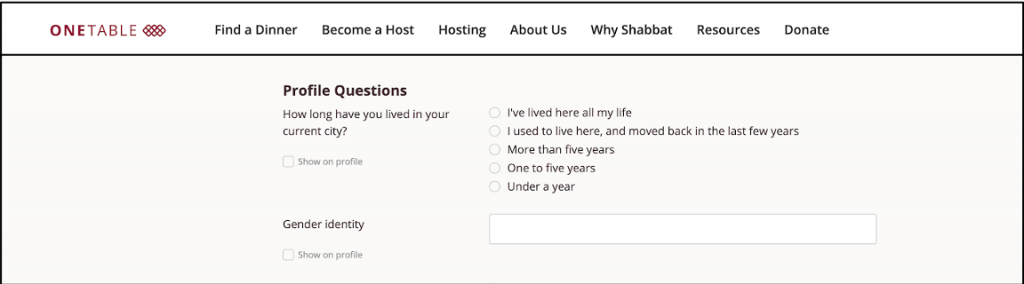
This form from OneTable uses an open “Gender identity” field.
If you think that you may need to know the gender breakdown of your programs or you are using a database that struggles with open-text fields, the approach that we recommend is a “multi-select gender identity list.” This approach offers a multi-select list in which users can select from a variety of gender terms, or fill in a “prefer to self-describe” option. The benefit of this approach is that it is far easier to search, sort, and analyze the resulting data.
If you are building a list of gender terms for a list like this, remember to be expansive in the options you include. And remember, the terms male and female describe sex, not gender. (Need a reminder on these terms? Check out Keshet’s extensive terminology primer.) A sample list could be:
Which of the following best describes your gender?
(select all that apply, terms in alphabetical order)
Please note this sample list is useful for program registration, membership forms, and other day-to-day settings. It does not ask whether respondents are transgender, as this information is generally not relevant for program registration. If you have determined that knowing if your participants identify as transgender would be useful to your data collection—especially if it will help ensure that attention, resources, or other meaningful support becomes available as a result of having this information—it is a best practice to ask a separate question immediately following that reads:
Do you consider yourself transgender?
(We recognize that identity is complex and people use many different terms to describe their relationship to gender. For the purposes of this survey, we are interested in the broadest definitions of the term, and include all people whose gender identity is different than was assigned to them at birth).
An alternate approach is to ask this question as part of a later, separate, opt-in demographics section. In that case, you might consider asking:
Do you consider yourself LGBTQ+?
If “yes” is selected, respondents receive a follow-up question that asks:
Which of the following identities describe you?
(select all that apply, terms in alphabetical order)
This approach has the benefit of helping you identify a raw number of individuals who are LGBTQ+ overall (which is often difficult when the questions about gender identity and orientation are separate because so many people are both transgender/nonbinary and LGBQ+). This approach is not appropriate when collecting initial program-related data about individuals. It is appropriate for certain high-intensity programs for which you would ask a series of demographic questions for analysis, placing this question alongside other identity-related questions in an optional “demographic information” section that you will analyze and use to understand your community better.
For further considerations and guidance on collecting demographic data from historically marginalized communities, please refer to Charles and Lynn Schusterman Family Philanthropies’ More Than Numbers: A Guide Toward Diversity, Equity and Inclusion (DEI) in Data Collection.
Here, as in all places where respondents can write in their own terms, we recommend the phrase “prefer to self-describe” and do not recommend the term “other.” Presenting identity terms as “other” (i.e. man/woman/other) quite literally others the people who hold these identities! In the context of a long history and renewed efforts to stigmatize and erase nonbinary and gender-diverse identities, using the term “other” can be deeply alienating.
In some cases, you may find that you need to work creatively around the restrictions of older or outdated database systems. See the “Working with Databases” section below for possible solutions.
Pronouns are the words used to describe a person in the third person, and are often helpful to collect during program registration. (You can read more about why pronouns are important in Keshet’s pronoun resource).
This should always be an optional rather than a required piece of information. Usually, it is better to allow respondents to write in their own pronouns. If you are using a list, make sure that it offers a variety of commonly-used pronouns, including they/them, and a space to write in pronouns that are not listed. The list should be a multiselect list (i.e. allows users to select as many pronouns sets as they need to).
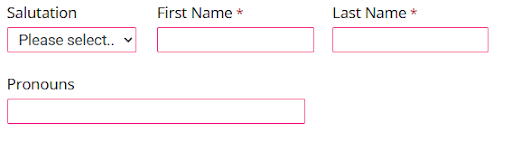
Pronouns
(select all that apply, terms in alphabetical order)
Do you want your pronouns printed on your name tag?
Please note that the once-common phrase “preferred pronouns” is no longer recommended, as many take it to imply that a person’s pronouns are “merely a preference” rather than the correct way to refer to that person. We recommend simply asking for “pronouns.”
You can also include a line explaining what pronouns are and why you are asking for this information. For example: “Please share your pronouns. Pronouns are the part of speech used to refer to someone in the third person. We want to know how to respectfully refer to you!” Alternatively, you can include a link to further information such as https://pronouns.org/.
For some events, you may be pre-printing nametags. If you are doing this, it is helpful to include a checkbox asking whether participants want their pronouns displayed on their nametag (and, of course, you can always provide pronoun stickers at check-in, whether or not you collect the information at registration).
Titles and honorifics should always be optional. In most settings, it is becoming common to collect information only about professional titles (Dr., Rabbi, Cantor, Professor, etc.) rather than honorifics that refer to gender or marital status (i.e. Mr., Mrs., Ms.). There may be some communities where using honorifics that refer to gender or marital status is preferred. In those settings, include a gender-neutral title option like Mx. (pronounced “mix”) which is a gender neutral honorific equivalent to Ms. or Mr. For more information about this honorific, see the “Mx.” entry in the Unabridged Merriam-Webster Dictionary.
People live in a wide array of family structures and households. To ensure that all families are respected and that your organization can accurately collect all of the relevant information, use inclusive language and build flexibility into your forms.
When collecting household information (such as for synagogue membership), it is best practice to ask for information about “Adult 1,” and to allow the user to “Add Adult” and “Add Child” until all members of the household are listed.
When collecting information about parents or caregivers of a minor (such as school or camp registration, b’mitzvah intake, etc.), a slightly different approach allows you to collect information accurately when children live in multiple households (as in shared custody arrangements, etc.). When collecting information in this way, it is best practice to ask for “Household 1” or “Primary Address,” and collect information on all parents/guardians at that address. Then, allow the user to “Add Another Household” and include information about all parents/guardians in that household.
When collecting information, use language that is gender-neutral and open-ended rather than making assumptions.
In some cases (employment, verifying eligibility for something, needing to coordinate with other agencies, etc.), an organization will need to ask for information about a person as reflected on a legal document. You may need to be aware of a name or a legal sex marker that they do not use. In order to avoid confusion and to be respectful, it is important to:
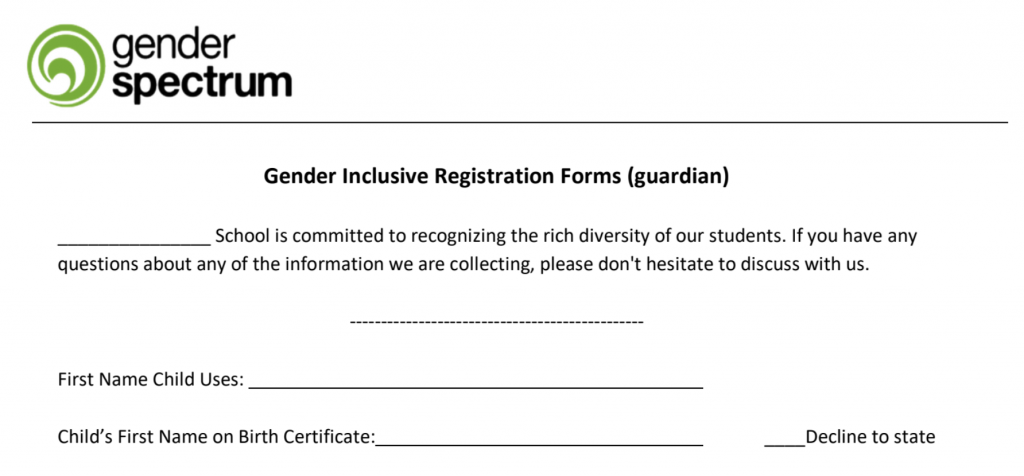
This form from Gender Spectrum shows open fields to indicate a child’s preferred name as well as the name on their birth certificate.
In addition to collecting accurate data, the quality of your data depends on it being kept up to date. All of the fields listed above (as well as addresses, phone numbers, and other critical information) can change over time. It is important to offer a clear and easily-accessible process for individuals to share updates.
When possible, it is best to create a way for people to directly update their own information. Many database and membership systems allow people to log in directly and make updates without needing to reach out and request a change. This is the option that will enable the most timely and accurate updates, and has the added benefit of privacy and simplicity. This way, a person who might be changing sensitive information can do so without having to feel the added pressure of reaching the right person, having a difficult conversation, or worrying about unwanted comments. It is also important to include contact information for the person who can answer questions or assist people who may be having difficulty logging in.
When this is not technologically possible, it is important to provide clear information on how people can update their information—typically offering both an email and a phone number to contact.
In order to get the most accurate and up to date information, we recommend including a reminder of how to update one’s information in the footer of emails or mailings, as well as to send out a message once a year asking people to review their contact information.
Many organizations are already working within existing databases or CRMs (Customer Relationship Management systems). All databases are customizable, to some extent. Many of them will allow the renaming of fields, or the creation of custom fields, so that you can implement updated language. Some will allow a space for notes or custom memos.
In most cases, a conversation with the Database Administrators (whether they are on staff or external consultants / IT support) will help you understand which of the best practices outlined above are going to be the best fit, and what it would take to implement desired updates.
If you are not working with an existing system (or are in the process of updating your data management), make sure to consider the best practices above when selecting software and designing your database.
Some older systems present substantial obstacles to collecting data in respectful ways and will require some creative and imperfect work-arounds. For example, if you are using a system that only allows three options for gender, you could include a short explainer text that says “We recognize that there are many more gender identities than can be listed here. Currently, our database system only provides the options of ‘man,’ ‘woman,’ and ‘nonbinary/other.’ Please select the option that best approximates your experience. We will provide space elsewhere on the form for you to share any more nuanced or authentic language with us,” and include an open-text field that allows users to do so.
If your database only allows single-select options, you can include some explanatory text that recognizes the limitations of having to select a single option like: “We recognize that people can have multiple gender identities. Currently, our database system only allows for choosing one option in the list provided. Please select one option that best approximates your experience and we will provide space elsewhere for you to share more.” And also add an optional open-text field below it that allows users to “tell us more about _______.”
Keep in mind that databases and CRMs are businesses whose financial success depends on meeting the needs of their customers. By continuing to ask for data systems that meet the needs of the people you are serving and align with your values, you can raise the bar for everyone and ultimately benefit the providers as well by helping them improve their products. If you find that a vendor is reluctant to make the needed changes to your system, it is always worth weighing other provider options to get the product you need. Doing so can demonstrate that respect and equity are core values that shape your organization’s spending decisions.
The best practices outlined above are primarily designed for registration forms, membership paperwork, program intakes, and similar forms, and are focused on how the information will be used in the day-to-day operations of your program.
When collecting demographic data for analysis, there are many more considerations. In general, historically marginalized communities benefit from detailed, accurate, transparent, and quality data that includes information about personal identity. The data can help the community, leaders, funders, and service providers understand how many members of historically marginalized communities there are and help reveal needs, successes, and disparities impacting these communities. At the same time, collecting such data requires trust and transparency and often involves asking questions that feel quite personal or vulnerable.
A full overview of community-scale data collection and analysis is beyond the scope of this resource. For further information about why, when, and how to collect this kind of quality demographic data, we recommend Charles and Lynn Schusterman Family Philanthropies’ More Than Numbers: A Guide Toward Diversity, Equity and Inclusion (DEI) in Data Collection.
Keshet envisions a world in which all LGBTQ+ Jews and our families can live with full equality, justice, and dignity. Stay connected by joining our email list and following us on social media.






National Office - Boston
1860 Washington St.
Newton, MA 02466
Phone: 617.524.9227
New York / Bay Area / Chicago / Florida / Texas