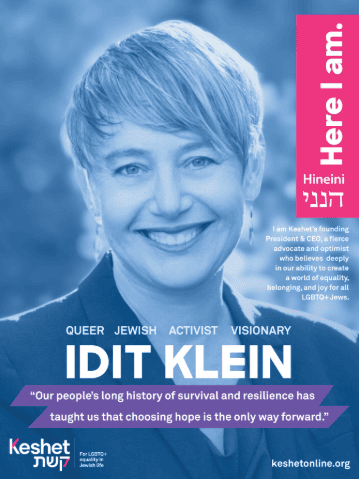
Jewish LGBTQ+ Hero Poster Series Curriculum — Idit Klein
Students will learn about contemporary LGBTQ+ Jewish hero Idit Klein and explore how her history of changemaking can inspires their own work and visions for justice.
August 18, 2026
By EJ Tench & Rabbi Eliana Kayelle
Introduction
Time: 50 min
Age: 12+
Materials:
LGBTQ+ Jewish Heroes poster
Technology to show a video with sound
Video clips
Printed copies of 7 Jewish Values for Social Action
For Activity 1
Paper chain material, scissors, tape
For Activity 2
Printed off expert of speech for sticky note poem activity
Goals:
Understand moments of Jewish LGBTQ+ legal successes through Keshet’s work
Explore Idit’s history of change making and how that inspires our own justice goals for the future
Considerations: Keep in mind that LGBTQ+ people learning about instances of discrimination against their own identities, and experiencing the reaction of other participants, can be difficult and upsetting. Bring sensitivity and understanding to facilitation when leading participants through such content.
Frame (3 min)
Today we will be learning about a contemporary Jewish hero. It’s important to learn about Jewish heroes because there are so many extraordinary Jews in our history and present who have made important contributions to the Jewish people and the world at large. It’s also important to learn about lots of different Jewish heroes because it uplifts the fact that the Jewish community is diverse, and there is no one way to be Jewish. Today we are going to learn about Idit Klein.
Opening (5 min)
“Our people’s long history of survival and resilience has taught us that choosing hope is the only way forward.” [quote on Idit’s Poster]
Opening Prompt
Think about a story or event you know about LGBTQ+ and/or Jewish resistance/resilience
What was the story and event?
What was a moral, ethic, or lesson you took away?
What did it feel like when you first heard about this?
Has the story or memory helped to inform how you show up in the world?
Turn to someone near you and share what is coming up for you. You will each have three minutes to share.
Learn (4 min)
Now we are going to watch part of Idit Klein’s speech from the 2025 “Making the Extraordinary Ordinary” Keshet Gala. In this section, Idit reflects on Keshet’s involvement in the fight for marriage equality in Massachusetts.
Mary Bonauto: “We took what was unimaginable and turned it into a joyous reality.” Idit Klein: “We took what was unimaginable, and we turned it into an ordinary reality.”
Which perspective do you relate more to?
What makes reality joyous, versus normal?
We’ve made great strides for LGBTQ+ rights. Do you think this new normalcy could lead to complacency? If so, how do we ensure there is not a backwards slip in LGBTQ+ rights?
Learn (6 min)
Now we are going to watch Keshet’s 2018 Yes on 3 Campaign video, a campaign to protect transgender rights in Massachusetts.
Either as a whole group, or in smaller groups, discuss the following:
A 2018 ballot measure was necessary to protect a 2016 law. What does this tell us about the continuity of progress?
Do you think progress is linear? Why or why not?
How would you describe the shape of progress?
Facilitator Note: As an example, share Martin Luther King Jr.’s quote, “The arc of the moral universe is long, but it bends toward justice.”
In this video, you heard a variety of steps Jewish organizations took to create change: phone banking, get-out-the-vote work, launching campaigns for trans youth, and hosting public education programs.
What steps have you participated in? If you have not yet, what ones would you like to?
What are other action steps your community can take to protect LGBTQ+ rights?
More than 200 Jewish organizations, across denominations and traditions, signed on to Keshet’s Kavod Achshav: Dignity Now campaign for transgender youth.
What language and approaches do you think best bridge points of difference?
“Look to Adonai, be strong and of good courage! Look to Adonai.” – Psalm 27
“Hope for Adonai, and if your prayer is not accepted, reinforce your hope.” – Rashi
“On a similar note, Rabbi Ḥama, son of Rabbi Ḥanina, said: A person who prayed and saw that he was not answered should pray again, as it is stated: ‘Hope in the Lord, strengthen yourself, let your heart take courage, and hope in the Lord’ (Psalms 27:14). One should turn to God with hope, and if necessary turn to God again with hope.” – Berakhot 32b
Discuss (6 min)
What do these texts tell us about the nature of hope?
What does hope feel like to you?
What are some ways you reinforce your hope?
Create/Wrap-Up (10 min)
Prompt Question for Activity
Facilitator Note: choose one activity for the group
“What vision of justice today feels beyond our collective imagination, yet in 20 years, will simply be the ordinary reality of our lives?” [quote from Idit’s 2025 Gala Speech]
Activity 1 – Paper Chains
Writing their dreams/goals for community change to create paper chains
Each participant should receive 5-7 strips of paper they can write on and tape should be available
Using inspiration from Idit’s speech, participants should write one dream or goal they have for their community onto each strip of paper.
Once everyone has written on their own strips they should connect them by looping them through each other creating a small chain.
Discuss how each of their dreams connects to the others they wrote down
After that participants connect each of their individual chains together to form one long garland (have some extra strips available to loop them together)
Discuss how all of their dreams can work together to make big change in their communities, it takes all of us to uplift each other, and how all of our dreams for a better world are connected. When we change one thing it has a ripple effect to many other things.
Activity 2 – Sticky Note Poetry
Creating a poem as a group from the impact of Idit Klein’s powerful words.
Read the transcript of Idit’s speech and underline the words that jump out. It could be because they resonate in a particular way, you find them powerful, you think other people should know them, etc.
Write each word on its own sticky note
Divide large group into smaller groups of 3-5. They should bring their sticky notes with them.
As a group they should arrange all of their sticky notes with meaningful words into a poem about hope and resilience. If multiple people have the same word, that’s okay! They should use the repeated words in their poem in some way.
Once all groups are finished they can take turns reading their poems to the rest of the group.
Questions after shareback
What did you notice about these poems?
Did they have any words or phrases in common?
What gives you hope during challenging moments?
Leaning into hope, what dreams do you have for the world in the next 20 years?
Keshet envisions a world in which all LGBTQ+ Jews and our families can live with full equality, justice, and dignity.
Stay connected by joining our email list and following us on social media.