By Sage Cassell-Rosenberg
Keshet’s Flowers For Our People: An exhibit of LGBTQ+ Jews of Color centers photography by Luis Mercedes Winter that reimagine iconic figures from Jewish texts through the lens of LGBTQ+ Jews of Color, accompanied by reflections by Saffron Mala Kaplan, weaving together ancient stories and contemporary expressions of identity to affirm our timeless presence within the Jewish community.
Here are excerpts from the exhibition in honor of Transgender Day of Visibility—photographs and stories of Adam and Joseph that shine a spotlight on trans Jews of Color, accompanied by poems by Sage Cassell-Rosenberg, Ziggy Valdez, and Nasiyah Isra-Ul.
Share these photographs, these stories, these poems, these prayers of and by LGBTQ+ Jews of Color with your community this Trans Day of Visibility.
When reading the first two chapters of Genesis, a number of questions may arise. One of these questions is: were man and woman created at the same time (as seen in Genesis 1) or was man created first and woman then created out of man’s pre-existing body (as depicted in Genesis 2)? As a way of rectifying this seeming contradiction, the rabbis suggested that the first human — HaAdam, The Adam — was created as both male and female in one. It was only after they found themself needing companionship that the Human was split into two parts, one male and one female. The biblical narrator tells us that the Human was created in G-d’s image; surely, then, all of us — men, women, and everything else — are all sacred reflections of the divine.
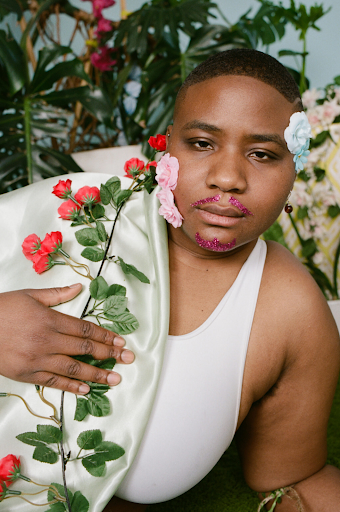
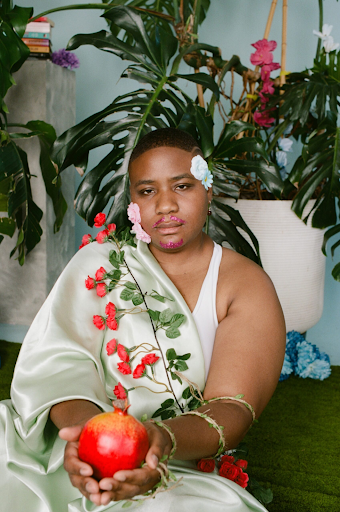
While being trans is nothing new, it is only in the modern era that trans people not only have the language to describe their experiences, but also the ability to transition both socially and medically. In these photos, we imagine a version of Joseph who embodies all of these possibilities.
Midrashim on the Book of Genesis teach that Joseph was originally conceived as female, but was physically changed to male in the womb (and vice versa for Joseph’s half-sibling Dinah). Through our modern lens, the narrative of being born into a “male” body with a female soul reads exactly as we now understand the trans feminine experience. With this new understanding of Joseph, many other seemingly disparate parts of her story suddenly make perfect sense. The term for Joseph’s “technicolor dreamcoat”, k’tonet passim, also appears in the Book of Samuel to describe the “princessly robes” worn by Tamar, King David’s daughter. Rather than Jacob unfairly favoring one of his children with this gift, perhaps he recognized his daughter for who she really was and attempted to provide her with gender-affirming clothing—an act tragically misunderstood by Jacob’s sons, leading them to commit horrible acts of violence against their vulnerable sister for innocently expressing her identity. Later in Egypt, Pharaoh changes Joseph’s name to Zaphenath-Paneah, meaning something like “revealer of hidden things”—a perfect name for a trans woman who, after years of hardship and ostracization, is finally able to live openly as her true self.
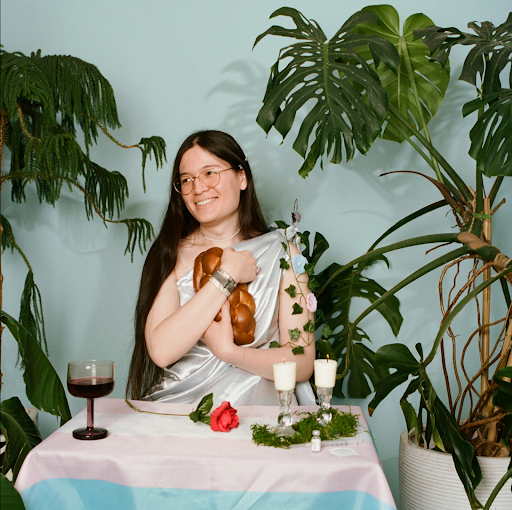
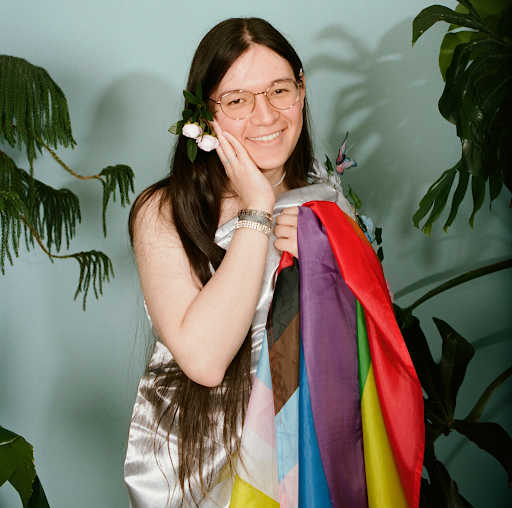
To see the full Flowers for Our People Photo Exhibit, visit the FFOP page.
Being Trans Is to Love Ourselves Completely
by Ziggy Valdez
“Being trans is to love ourselves completely”
You said that and I felt my heart swell
It was like being seen for the first time
All of the blood, sweat, tears, and hormones The sweltering days in hoodies to hide my body
The cold nights in hospitals at war with myself
You acknowledged scars you haven’t seen yet
And stories not yet told of how I got to be sitting next to you
I see and feel how much you love yourself And now I see it in myself
Something I honestly didn’t think I could do
This isn’t quite a love letter
But more so a thank you For seeing me
And allowing me to love myself
My Mess Is My Masterpiece
by Sage Cassell-Rosenberg
Finding myself, creating myself, crafting this flesh vessel that I occupy.
It was labor.
I gripped the edge of my seat and pushed.
I pushed, and I bled through the tears.
Through my own gray fog of dissociation.
Through the murky waters of indecisiveness.
And through the pain that occupies the pits of my stomach.
Who am I?
What am I?
What do I want?
Does it even matter who I am?
Does it even matter what labels, identities, and titles I assign to myself?
Does any of this really matter in the grand scheme of things?
I love to be loved, but often fear being loved for who I really am.
I paint an image over an image, over another image.
I paint, and I paint, and I paint.
And the more I dip into the pot of paint,
the farther I feel from my own canvas.
I paint myself in an ever-changing array of shades.
Will they prefer blue? I think as I paint in a shade of Baby Boy Blue.
What if they prefer pink? I think as I mix a shade of Baby Girl Pink into the shade of Baby Boy Blue.
But what if they prefer something more neutral? Something like yellow?
I paint, and I paint, and I paint.
My hand shakes with every brush stroke,
with every glide,
with every caress.
And as the colors begin to bleed and blend,
I forget the color I was originally going for.
There’s that voice again.
The voice that tells me, You’re doing this wrong.
And I ask, Doing what wrong?
And it answers back,
Everything.
I paint as I am drowning in hypotheticals,
in fictional rejection,
in imagined judgment,
in my own self-imposed isolation.
Existing in the uncertainty of whether or not the colors I paint
are what I want,
or what I think others want.
And I scream as I clutch my chest.
Through my labored breathing,
I feel the thud of my own heartbeat.
I feel the clammy, cold sweat
through the tremors of my hand.
I feel as if I’m dying, and I begin to wonder,
Am I even alive?
And then…
Like a warm embrace,
another voice washes over me, asking,
Do you want to be alive?
I pause…
And eventually say, I do!
The voice whispers back,
Put the paintbrush down and look in front of you.
I look at the abysmal mix of colors I’ve created
that could only be described as a murky, muddy gray,
and say, I think I’ve made a mess.
The voice then says,
Wipe it all down until it’s clean again.
Every word feels like a kiss,
every syllable a gentle embrace,
every noise lays to rest my anxiety
like a carefully crafted lullaby.
I look to my right and see,
next to my paintbrush,
a towel.
I dab it in the pool of tears at my feet,
and I begin to scrub.
And with every swipe, I feel relief.
With every gesture, I let out a deep breath.
I scrub, and I scrub, and I scrub,
until the paint, hardened by time,
begins to crack and crumble.
The paint is gone,
leaving an image plastered over another image,
which is plastered over yet another image.
I claw, and I claw, and I claw.
And as I claw,
I begin to see my own reflection.
And I smile.
I smile because I recognize this reflection.
A breath of warm air washes over me once again
and whispers,
You’ve finished. You’ve created a masterpiece.
And so I walk away,
because my work here is done.
We Are Light
by Nasiyah Isra-Ul
Bolts
Thunderous and rebellious
Sparkling and shifting
We are light.
Soaring high above
the noise,
the Divine spark aflame
within us.
Call us light.
We embody
the rise of dawn
and the varying
shades of dusk.
We are light.
Beyond the noise,
we daven strong.
as melodies,
as poetry,
as dance,
or just as pure
energy.
Call us light.
No chains leave us bound,
we break every fetter
because we are
fiery, fierce, unquenchable
LIGHT.
Shining.
Shining.
Shining.
We are light.
Why then, do people try to silence us?
Why then, do people try to hide our spark?
To tell us we don’t belong,
that we have the wrong kind of luminous beauty?
Our light comes from
the same source as anyone else’s.
We are all light, so
call us light.
Keshet envisions a world in which all LGBTQ+ Jews and our families can live with full equality, justice, and dignity. Stay connected by joining our email list and following us on social media.






National Office - Boston
1860 Washington St.
Newton, MA 02466
Phone: 617.524.9227
New York / Bay Area / Chicago / Florida / Texas