By Rachie Lewis, Senior Writer
Off the work clock (and sometimes on the work clock), I am downright obsessed with the WNBA. For the past six years, I have been rapt by the ascending star that is this incredible league of incredible athletes. As the storylines of the W and Keshet’s work have intersected, for good and for bad, I’ve wondered when the moment would come, that I could write something for this esteemed publication.
And that moment has arrived.
You might think it’s because the WNBA was hijacked for much of this season by an anti-trans grifter who happens to check all the boxes of traditional femininity that so many other players don’t: Sophie Cunningham. Well, yes. Her bigoted comments platformed by hateful right-wing media; her inability to take responsibility for causing harm to her teammates, the rest of the league, and fans that had to deal with parasitic protesters at many games; and her parallel race-baiting that has been her signature for years, have been such a blemish on this season and on the reputation of the league, and have inexcusably made games feel unsafe for many players, and many queer fans and for many fans of Color. But now her season is over, and her team has been vanquished from the playoffs, an outcome that I believe was informed by the hateful firestorm she set in motion.
So Baruch Hashem, thank God, now we get to move on. We get to fully bask in the amazingness of what remains, that is so joyful, so damn good, and so damn queer—which, in truth, is what it has always been.
It turns out the story of the WNBA this season is about the two teams left in the WNBA Finals who both rose above the destructive narratives and defied—queered, one might say—the expectations of what a championship team could be: the Atlanta Dream and the Golden State Valkyries.
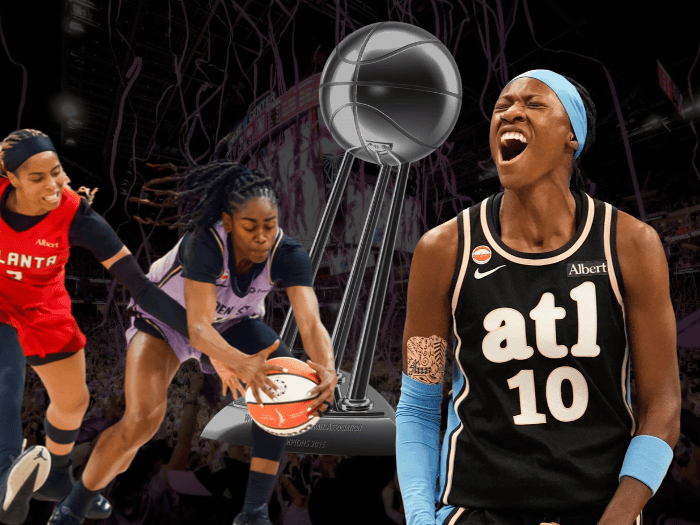
Six years ago, the Atlanta Dream were owned by a Republican Senator named Kelly Loeffler, who, during the height of the activism that George Floyd’s murder activated, scolded the Dream and other WNBA players for using their platform to protest police brutality against Black folks. Her own players responded by throwing down hard for Raphael Warnock, Loeffler’s opponent in the 2020 senate race. In fact, after the Dream and other WNBA players started wearing “Vote Warnock” t-shirts before games, his fundraising numbers skyrocketed. Loeffler proceeded to lose her Senate seat, and was forced to sell the team. And the ownership group that bought it included Renee Montgomery, a queer, Black, former player who had been a key leader in WNBA activism.
Six years later, the new owners and new stars like Angel Reese, Jordin Canada, Rhyne Howard, and Alisha Gray have built a team that can hang with the best of them and has one of the fiercest defenses in the league. They rebound the hell out of the ball, and they have a dedicated local fan base growing in droves by the day who just filled a 17,000 seat arena for Game 3 in an amazing showing of strength and poise by the Dream.
Then there is the Golden State Valkyries, a team that in just their second year has unbelievably made it to the WNBA Finals. Their team is full of players de-prioritized by their former teams and who all have something to prove because of it. And their coach, Natalie Nakase, has known just what to do to bring the best out of them. Gabby Williams, Veronica Burton, Kayla Thornton, Kiah Stokes. They are now stars who play amazing team defense and they set the pace of their games. Anyone on their team can be the star on a given night and knock down threes from anywhere. And their fans? They sell out every homegame and everyone in the W says they are the best in the league. The atmosphere of their arena, known as Ballhalla, is magic. They make their team feel beloved and like they can do anything.
One journalist called these playoffs, the playoffs of friendship, because it’s not superstars who are winning this year, it’s not the teams that had all the attention and fanfare, but rather the teams that are so connected, and love each other and help each other’s stars shine brighter.
And that is why this is relevant to Keshet’s work creating a world of belonging, equality, dignity and joy for all—building the world to come. We at Keshet do the same thing. Shabbatonim for LGBTQ+ and ally Jewish youth where queer teens can show up fully as themselves? The Keshet Neshamot/Rainbow Souls Shabbaton for Queer Jews of Color where no one has to check any part of themselves at the door? Training shuls and schools and camps to be communities of full belonging? Working together in winning partnerships across lines of difference? Even in the face of so many challenges and haters? We are building the world we need. And at a time when it feels like everywhere else we look is doing the opposite, the WNBA and the Atlanta Dream and the Golden State Valkyries are also showing us what the world to come can look like.
These athletes are incredible, this series and these games are must-watch television! As this league ascends even in the face of hateful opportunists trying to burn it down, viewership is breaking records, the players’ union has negotiated a historic contract, and people are gravitating towards a version of basketball that mirrors back what we need in the world. A place where there is no limit on our authenticity and greatness, where success does not come from complying with outdated and damaging gender norms the world might thrust upon us, but from defying them, and where teamwork and strategy can vanquish any foe,
So when you think of the WNBA, remember, what’s-her-name from Indiana is an afterthought. The story is about what it looks like to push through hate and political grifts, and build something new that is expansive enough for all of us. Including me. And including you!

National Office - Boston
1860 Washington St.
Newton, MA 02466
Phone: 617.524.9227
New York / Bay Area / Chicago / Florida / Texas