For years now, my home state of Florida has been the center of institutionalized LGBTQ+ discrimination, hatred, and violence. From the passage of infamous executive orders and laws, such as the “Don’t Say Gay” Bill—which bans gender-affirming care and many Gender Studies curricula, as well as obligates teachers to out their students to their parents and legalizes hiring discrimination in healthcare fields—to terrible examples of violence, such as the Pulse Nightclub shooting in Orlando, hatred against the Queer community has been normalized; as a result Queer people in the state have been conditioned to be afraid and to believe that their voice neither matters nor should be expressed, resulting in the ultimate erasure of Queer identity, locally. The worst aspect of this hatred involves the idea that such hatred is a “moral” obligation—that the LGBTQ+ community is supposedly unnatural and impure, therefore deserving of such hatred. This idea frequently originates from one’s religious values and the stereotype that those who are devout must also be in opposition to the Queer community; however, Keshet proves the opposite. Through various Jewish ideas and values—including B’tselem Elohim (the idea that we are made in God’s image) and the merit of Pikuach Nefesh and Tikkun Olam (saving a life and repairing the world, respectively—Keshet demonstrates how religion teaches its followers to be good, kind, moral people who respect others, as well as that religion and allyship for the LGBTQ+ community can coexist. Given the predominantly conservative, religious values of Florida residents and representatives, I wanted to use the knowledge and skills I gained as a Keshet Youth Advocacy Intern to show others—including state representatives—that religion and allyship can coexist, and that the state’s discriminatory laws must end, as an example that hatred must not be welcome in the Sunshine State.
In order to accomplish the aims of my project, I was struggling to decide whether I should focus on canvassing, in order to show local residents that supporting the LGBTQ+ community is a religious and moral value, or postcard-writing, to convince our representatives to reconsider their policies on LGBTQ+ issues on the basis of more progressive religious thoughts and/or overwhelming support for the Queer community. With both concepts having clear merit, I decided to merge the two elements into one cohesive project: particularly, I elected to canvas my fellow local residents and ask them to sign their names and addresses on a postcard which would be sent to four different local representatives. Each postcard also included a section separated by a dotted line, which could be removed and kept by those who signed for them to continue the fight for LGBTQ+ equality by contacting the representatives individually. After formulating this concept, the first real “step” of my project involved selecting the representatives to whom I wanted the postcards to be sent.
As previously alluded to, I wanted the signed postcards I collected to be sent to four different electeds—I felt that this would be an appropriate number as it’d be enough to make a difference while not too many as to be overly ambitious or unlikely to fulfill. The first elected I had selected to be included in the postcard campaign was Governor Ron DeSantis, as he is the state’s governor and as he is the individual responsible for many of the state’s most discriminatory and anti-LGBTQ+ laws. I also selected U.S. Senator Rick Scott, as he has shown some support for the Queer community after the Pulse Nightclub shooting, but has not necessarily followed through with this support. Finally, I included local Florida Senators Lori Berman and Mack Bernard, both of whom are more progressive members of the Florida Senate as well as local representatives in the county in which I hosted my canvassing. Further, I also thought it would be best to send the postcards to Lori Berman as she has been a long-time supporter of the LGBTQ+ community, but also as she is the Florida Senate Minority Party Leader, meaning she has an incredible amount of influence. More information about these electeds could be found in Link One, a document which was prepared with the purpose of detailing the relevant LGBTQ+ positions and legislative actions of each elected; this document was meant to enable those who were canvassed to learn more about the electeds should they choose to contact them.
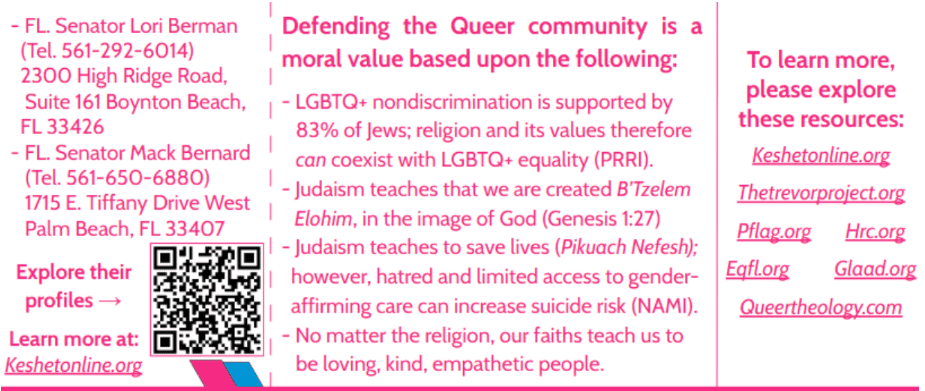
The next “step” of my project was to create the postcards that would be used during canvassing and would then be sent to each of the four electeds. This process involved researching different information as well as creating a couple of different drafts to make sure that all of the necessary information was included, but also that the format was appropriate, natural, and user-friendly. The final draft of the postcard can be seen in Figures One and Two. The front of the postcard (Figure One) includes, from left to right, Keshet’s logo, a short message where residents can include their name and address information, and a removable section that details the contact information of two of the included electeds, should the residents choose to continue Keshet’s fight. The back of the postcard (Figure Two) includes, from left to right, the back of the removable section which contains contact information for the other two electeds, a link to learn more on Keshet’s website, and a QR code that connects to the document in Link One; a set of justifications as to why supporting the LGBTQ+ community is a moral value; as well as additional resources that could be used by the electeds. For clarification, the larger part of the postcard—including the logo, message, bulleted justifications, and additional resources—were sent to the electeds, while the additional contact information was given to those who were canvassed. Further, the message details the main goal or “ask” of the postcard campaign, while the justification information and additional resources could be utilized by the electeds in order to convince them that they are obligated to protect the Queer community as our representatives.
Upon completion of my postcards, I had the postcards printed and cut to be distributed during canvassing. After, with the guidance of my advisor, I elected to canvas local residents at my Synagogue as well as another Synagogue, on account of the fact that congregants would likely share similar values and beliefs surrounding Judaism. During my canvassing, I approached each congregant with enthusiasm, kindness, and respect and asked if they would be willing to sign a postcard to urge our representatives to better fight for and represent the rights of the LGBTQ+ community in the state of Florida. Each willing individual signed the postcard—after being informed that the postcards would be sent to the four electeds and after asking any questions they had—and removed the detachable section to learn how to continue the fight should they choose to do so. With my canvassing efforts, I collected twenty signed postcards. While I had wanted to do more, twenty postcards was a wonderful accomplishment given the amount of time I had to canvas.
After the postcards were copied using a photocopier, a set of twenty postcards was packaged and sent to each of the four selected representatives, using the address listed on each of the postcards. For full clarity, those who participated in the postcard element of the campaign were informed that their postcards would be copied in order to make a larger impact and share their beliefs to more than one representative—of course, each participant was also reminded that they could choose to opt out of this campaign should they choose to do so.
While only twenty postcards were signed and sent to the representatives, and though this may not seem like a lot when considering the number of constituents each representative has, these postcards have a decided impact. Particularly, while these postcards may not fully change the positions of the representatives with more concrete, conservative ideologies, even just twenty postcards and twenty residents voicing their opinions can pressure an elected. As they are public servants, electeds are obligated to go through the feedback they receive and do what is in their power to mitigate more negative sentiments and remain in their positions. Further, when confronted with situations involving the LGBTQ+ community in the future, these postcards can serve as a reminder of public opinion, encouraging them to make a different choice than they may have otherwise done so. Conversely, these postcards are effective with representatives who have already shown support for the LGBTQ+ community, as they can be used to remind electeds that their residents see what they have done for the community and urge them to continue doing so. As a result, I am very hopeful that these postcards will make a meaningful difference amongst the electeds that receive them.
While I am very proud of the difference that this project will make, I do believe that more could be done in the future to expand the aims and impact of this project. While I was unable to do so given the time constraints, I would have loved to do additional canvassing and collect more postcards. Further, I would have also wanted to send the postcards and its resources to other local
Synagogues, organizations such as JFS, and even others who may be interested in doing canvassing of their own. While these goals were unfortunately not realized, I sincerely hope to expand this campaign in the future, even though the internship is now concluded.
It has been my absolute honor, privilege, and pleasure to be in the 2026 Youth Advocacy Internship Cohort. I am so incredibly thankful for the knowledge of advocacy and politics that this internship has fostered, as well as for the support I received in executing a project of my own design meant to better the condition of a community with which I identify heavily. This experience has encouraged me to continue fighting for what I believe in and benefit from the privilege that living in a democracy offers through advocacy efforts. With Keshet’s determination to better LGBTQ+ Jewish life, I look forward to continuing my involvement into adulthood.
Link: Representative Profiles
Figure One: the front of the postcard
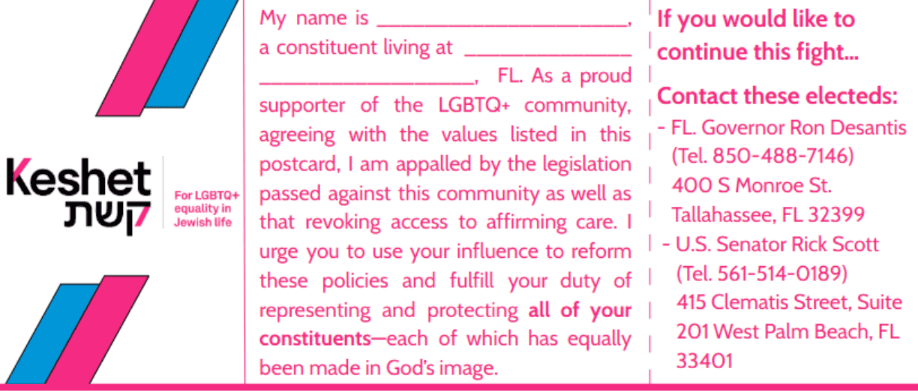
Figure Two: the back of the postcard

National Office - Boston
1860 Washington St.
Newton, MA 02466
Phone: 617.524.9227
New York / Bay Area / Chicago / Florida / Texas